Bucharest stands out on the real estate market in Central and Eastern Europe through competitive prices, limited supply, and real potential for convergence with major regional capitals. The rapid evolution of the premium and hospitality segments, along with the maturing demand, is transforming the capital into an increasingly attractive destination for discerning investors.
Competitive prices compared to major CEE capitals
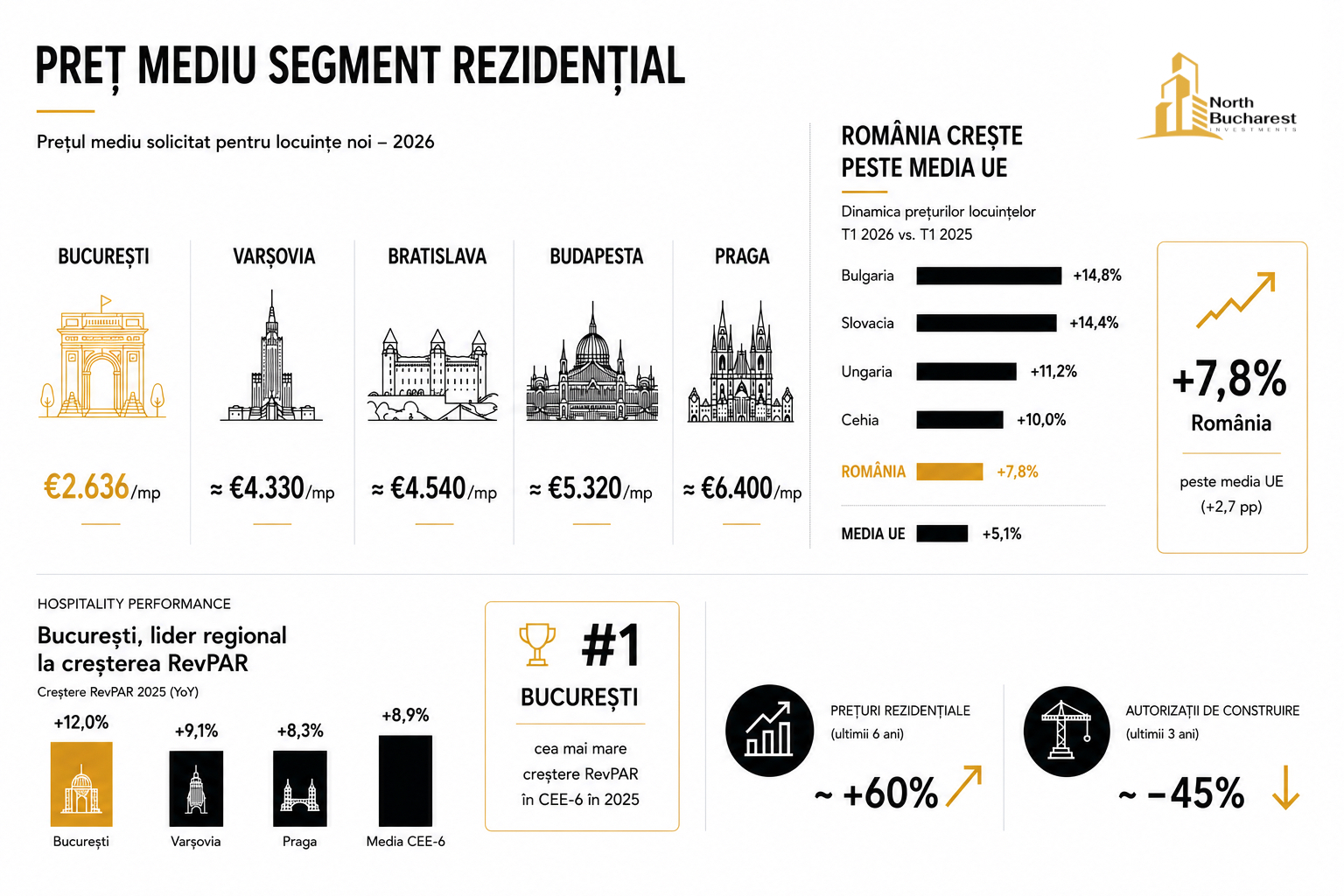
The residential market in Bucharest continues to offer entry values that are significantly more accessible compared to other capitals in Central and Eastern Europe. In 2026, the average asking price for new apartments reached approximately 2,636 euro/sqm.
The average price per square meter for new apartments in Bucharest is almost half that of Prague.
| Capital | Average price new apartments (euro/sqm) |
|---|---|
| Bucharest | 2,636 |
| Warsaw | 4,330 |
| Bratislava | 4,540 |
| Budapest | 5,320 |
| Prague | 6,400 |
Even after the appreciation of recent years, Bucharest maintains a price advantage and a relevant space for convergence, as the market matures and aligns with regional standards.
Limited supply and its impact on the market
One of the strongest structural arguments of the Bucharest market is the significant reduction in future supply. In the past three years, the number of building permits has decreased by approximately 45%.
- Housing prices have increased by about 60% in the past six years.
- New supply is becoming increasingly difficult to replicate in established areas.
- The rarity of well-positioned assets is becoming an essential value factor.
The reduction of the pipeline limits the market's ability to respond quickly to new demand cycles and accentuates the differentiation between standard products and hard-to-replicate assets.
Maturing demand and the evolution of the premium segment
The residential market in Bucharest is maturing rapidly, and buyers are becoming increasingly attentive to quality, efficiency, technology, services, and liquidity. The premium segment is being redefined, and demand is becoming international, supported by entrepreneurs, regional executives, expats, and the diaspora.
This audience evaluates Bucharest in comparison with other European markets, and value is no longer given by the simple square meter, but by the property's ability to generate and preserve value over time.
Vlad Musteață, CEO North Bucharest Investments: “Bucharest must be viewed today in a regional context. The difference compared to capitals such as Warsaw, Prague, or Budapest is not just a price gap, but also indicates the convergence space that the capital still has ahead. Value will concentrate in well-positioned assets, with infrastructure, efficiency, services, and liquidity.”
Performance of the hospitality segment
In 2025, Bucharest recorded the highest growth in RevPAR (revenue per available room) among the six CEE capitals analyzed: +12%, above Warsaw (+9.1%), Prague (+8.3%), and the regional average (+8.9%).
The capital ranks third in CEE-6 after ADR and RevPAR levels, after Prague and Budapest. This performance confirms the development of the hospitality segment and supports the emergence of new asset categories such as aparthotels and serviced residences, fueled by business travel, expats, bleisure, and medical tourism.
Bucharest as a regional destination for capital
Bucharest's investment argument is not based on a single indicator, but on the overlap of several trends:
- Competitive entry price compared to major CEE capitals
- Appreciation of residential values
- Contraction of future supply
- Maturing demand
- Performance of the hospitality segment
What are investors looking for in the new cycle?
Investors analyze not only the current price, but also the potential yield, long-term liquidity, and the asset's positioning compared to regional alternatives.
“We are already seeing a change in the way investors analyze Bucharest. The question is no longer just how much the property costs today, but what yield it can generate, how liquid it will be in five or ten years, and how the asset is positioned compared to alternatives in the region. Bucharest is starting to be analyzed as a regional destination for capital.” – Vlad Musteață, CEO North Bucharest Investments
Bucharest does not need to become the next Warsaw or Prague, but to consolidate its own position in Central and Eastern Europe. The difference between a simple property and a high-performing investment asset is becoming increasingly important in a context where capital is increasingly selective.
Conclusion: Limited supply, competitive prices, and market maturation are transforming Bucharest into a strategic destination for real estate investments in Central and Eastern Europe.